


Kęstutis Budrys in Yerevan: The Membership of Lithuania and Other Baltic States in the European Union Has Fundamentally Changed the Geopolitical Landscape
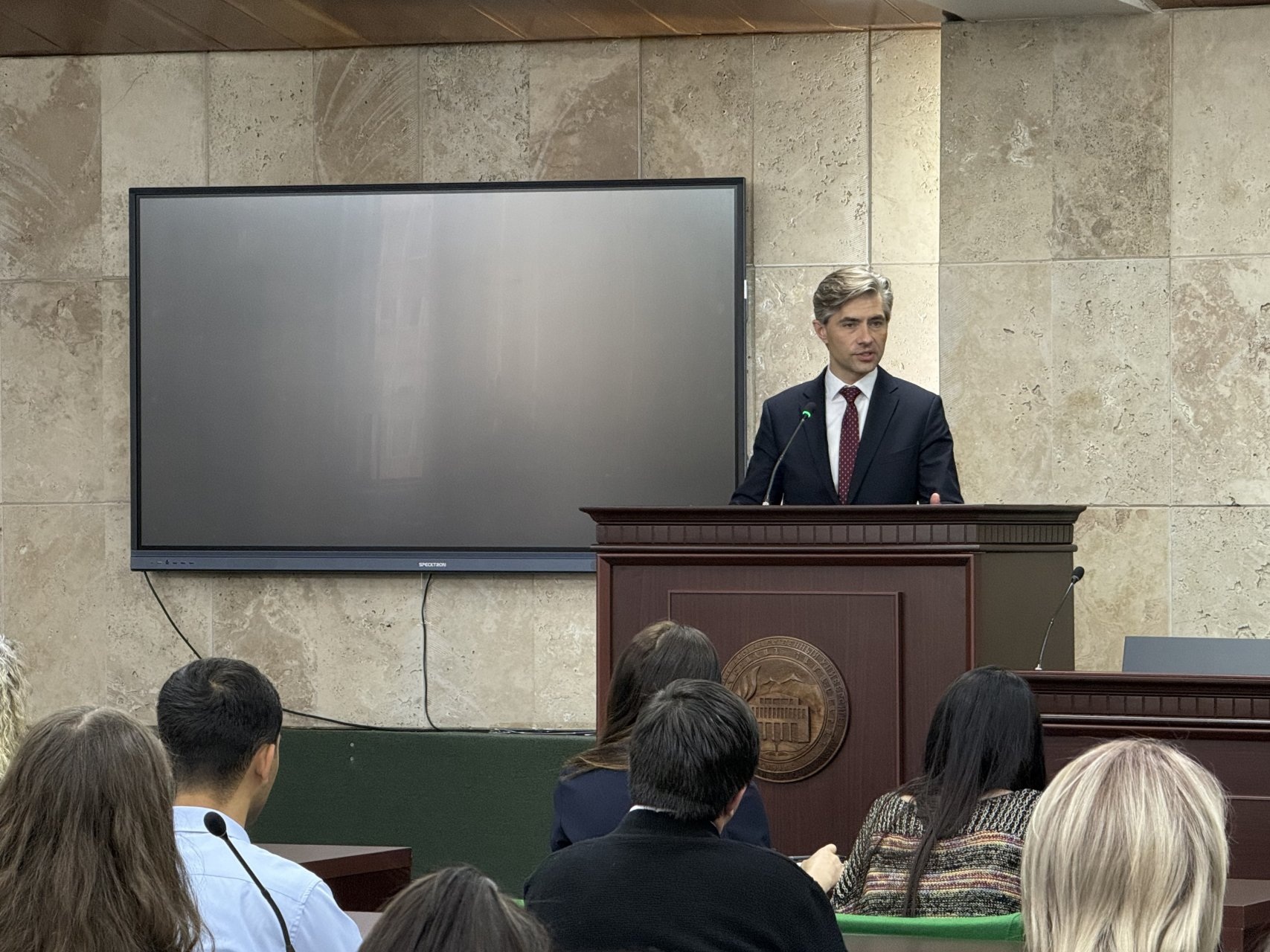
The Minister of Foreign Affairs of Lithuania, Kęstutis Budrys, met with students of Yerevan State University and delivered a lecture on Lithuania’s success story of EU integration.
During his visit to Armenia on May 19, the Minister of Foreign Affairs of Lithuania, Kęstutis Budrys, met with students of Yerevan State University and delivered a lecture on Lithuania’s success story of EU integration.
According to the head of Lithuanian diplomacy, the accession of the Baltic states to the European Union fundamentally changed the geopolitical landscape and determined their future. Over the past two decades, Lithuania has achieved rapid economic growth, stability, and security, overcoming dependence on Russia, implementing reforms that ensured successful state development, and becoming a success story of European integration and transformation.
“After the restoration of independence in 1990, there was no doubt that we had to integrate into the EU and NATO as quickly as possible. In pursuit of these goals, the young Lithuanian state faced many challenges, but it managed to meet the Copenhagen criteria and convince EU member states that we were ready for integration and submitted an official application for EU membership. This marked the beginning of a long reform process — we changed legislation and aligned it with EU standards. Although there were disappointments, we did not abandon the path of integration,” said Minister Budrys.
According to the Minister, over a little more than two decades Lithuania has achieved rapid economic growth — GDP has increased more than fourfold, while foreign direct investment has grown almost tenfold.
Today, as many as 92 percent of Lithuanians recognize the benefits of EU membership.
“EU membership provided access to a market of 450 million consumers, opened up new opportunities for businesses, increased exports, and attracted foreign investment,” Minister Budrys emphasized.
According to Minister, EU enlargement is a geopolitical necessity for the European Union and its key instrument for ensuring peace and security on the European continent, as well as for counterbalancing the threats posed by authoritarian regimes.
“Lithuania is firmly convinced that the EU is a stabilizing force. We will support countries seeking European integration on their path toward full EU membership. Successful enlargement means a deeper, broader, and more effective European Union,” said Lithuania’s Minister of Foreign Affairs.
The Minister also emphasized that transformation depends on countries’ choice to live according to agreed norms and principles, the most important of which are democracy, the rule of law, and human rights. The success of EU enlargement largely depends on whether candidate countries feel committed to European values and solidarity, as well as to the objectives of the EU’s common foreign and security policy.


